
Corruption Category Governance & leadership
Anti-corruption work on health system governance, which determines the primary objectives of a health system and the direction of policy and legislation needed to achieve these.
Chapters
Research
August 2020
Too much politisation, too little transparency
The Health Care Supervisory Office receives more than 2,000 appeals per year. In 2016, The Office assessed half of the 20141 complaints as unfounded. Most complaints related to patients' dissatisfaction with the provided medical care. The public is neither informed about the reasoning behind these decisions, nor about how the subject of complaint was prosecuted…
November 2019
Transparency and Accountability in Kenya’s Health Financing Models
Transparency and accountability on processes in the health sector in Kenya has been waning. In 2017, for instance, the health sector witnessed major challenges ranging from internal turmoil caused by health practitioners over corruption to poor service delivery leading to wastage of public funds. The U.S. Embassy in Kenya announced the suspension of approximately $21…

November 2019
Sectoral Risk Assessment in Sri Lanka
Despite an initial energetic start by the Sri Lankan Government with the creation of a number of bodies dealing with the SDGs, such as the Ministry of Sustainable Development and wildlife and the Sustainable Development Council to name a few, there has been little progress on their implementation, or of streamlining action across relevant ministries…
November 2019
Monitoring Report of Ministry of Health’s 2016 Improvement Plan
In January 2014, the Honduran government and TI/ASJ signed the “Collaboration and Good Faith Agreement for Promoting Transparency, Combatting Corruption and Strengthening Systems”. Since then, TI/ASJ has conducted independent monitoring and evaluation of the Ministry of Health’s performance in three areas: purchasing and contracts, human resources management, and data collection and evaluation. Based on TI/ASJ’s…
November 2019
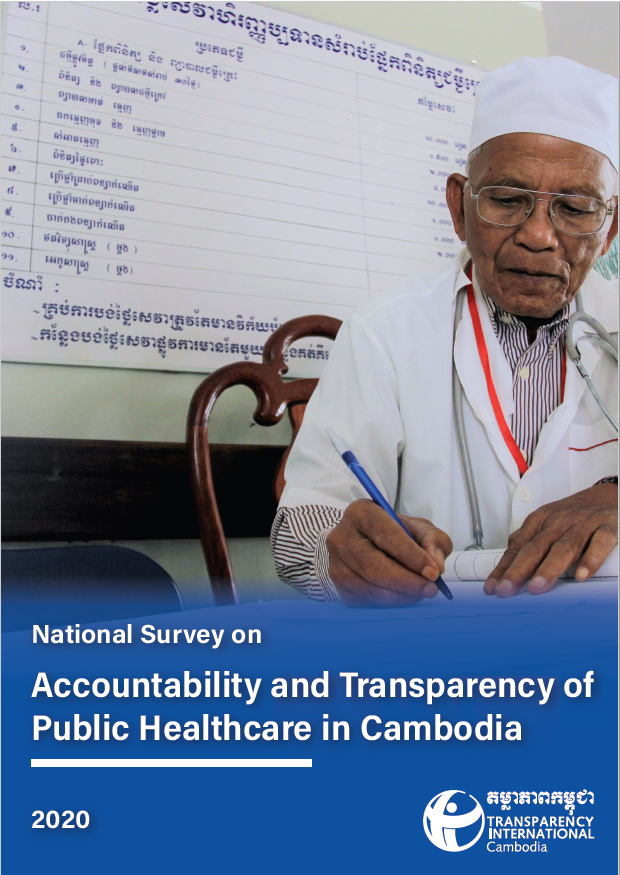
Public Perception Survey on Transparency and Accountability in Public Healthcare
A nationally representative survey on transparency and accountability in public healthcare in Cambodia. The survey seeks to quantify citizens’ perceptions, awareness and attitudes regarding the transparency and accountability of healthcare in Cambodia, and understand citizens’ experience in accessing healthcare in the country.
November 2019
Promoting Integrity and Reducing Vulnerabilities to Corruption in the Romanian Health System
Some of the priorities of Romania through the National Development Program 2007-2013 regarding health (priorities that overlap with those of the Government Program) are "increasing the accessibility of the population to health services", "improving the quality and safety of the medical act" ", "decision-making transparency in order to increase the efficiency in the use of…
November 2019
Governance of the Directorate of Drug Administration: Challenges and Way forward
The study assessed the effectiveness of the Government Drug Administration in tackling corruption. The study follows recent measures by the Government to strengthen the capacities of the Drug Administration. These include increasing the workforce in field offices, investing in capacity building, and enhancing the central drug laboratory. Moreover, the Government Drug Administration has taken measures…
November 2019
Corruption in Republic of Moldova: Perceptions vs. Personal Experiences of Households and Business People
With the support of the U.S. State Department and in collaboration with the Center for Sociological Studies, Transparency International Moldova carried out a study with the objective of analysing the perceptions and the experiences households and business people in the Republic of Moldova have made with corruption. The results of the study were used to…
Projects
October 2021
The Support to Anti-Corruption Champion Institutions (SACCI)
The Support to Anti-Corruption Champion Institutions (SACCI) Program in Ukraine is a five-year USAID initiative that has the objective to assist Ukraine in reducing corruption and increasing the accountability and transparency of the government. The programme seeks to empower key government institutions in fighting corruption, building public support for and engagement in anti-corruption efforts, and reducing citizens' tolerance towards corruption.
July 2020
Advocacy for budget for health sector
In order to efficiently combat Non-Communicable Diseases (NCDs), ANCE-Togo advocated for an increase of the health sector budget in Togo between July and September 2014.
ANCE-TOGO's continuous efforts incentivised the Togo government to increase the health sector budget for 2015.
Our teams also started a campaign that actively targeted the minister’s council and the national assembly to increase the health sector budget for 2018. As part of this campaign, parts of the ANCE-TOGO team met with several ministers, including the minister of health, the minister of economy and finance, and several permanent secretaries. They also met with several Members of Parliaments (MPs).
July 2020
Supporting the implementation of the WHO Convention on Tobacco Control (FCTC)
The project aims to improve public health through strengthening the Togolese Tobacco Control Law. The main objective is to achieve the integration of a 100% smoke-free policy and graphic pictorial health warning in the law in line with the WHO Framework Convention on Tobacco Control (FCTC).
May 2020
Pharmaceutical Procurement
This project involved the creation of the Forum for Transparency and Accountability in Pharmaceutical Procurement which brings together various stakeholders in the health sector including the Ministry of Health, CSOs, the Public Procurement Authority and others, with the objective of monitoring pharmaceutical procurement and supply chain management and improving transparency and accountability in the health sector. It also involved the development of a Mobile Drug Tracking System and the Drug Price Index to support pharmaceutical procurement monitoring.
November 2019
Improve Transparency and Accountability in Health Sector under Building Integrity Blocks for Effective Change (BIBEC) Project
The overall objective of BIBEC is to concentrate on building and strengthening a series of mutually supportive and reinforcing integrity blocks to effectively reduce corruption. “Blocks” hereby mean the key institutions, i.e., policy/law, education, training, ethics and values, and above all, the citizens of the country.
November 2019
Enhancing Community Awareness on the Linkage between Corruption and Human Rights
The Coalition for Accountability and Integrity (AMAN) worked throughout this project on sharing knowledge on the linkage between corruption and human rights by compiling a practical assessment for Palestine with focus on the fundamental right to health, increasing community awareness on this linkage, and empowering CSOs working on health to include integrity, transparency, accountability and anti-corruption perspectives in their work in order to hold officials accountable for corruption and violation of human rights.
Partners
Global Partners:
USAID European Union Swedish International Development Cooperation Agency (SIDA) U.S. State Department GlaxoSmithKline Plc. Novartis Department for International Development UK (DIFD)Regional Partners:
Governmental Institution
NGO or Civil Society Organisation
Hospital Health Management Committees
Ministry of Health
Center for Sociological Studies
International Agency
Media
Business
Individuals or general public